
Do Confidentiality Rules of Professional Conduct Prohibit Use of Google's Local Services Ads?
 Gyi TsakalakisCo-founder, AttorneySync

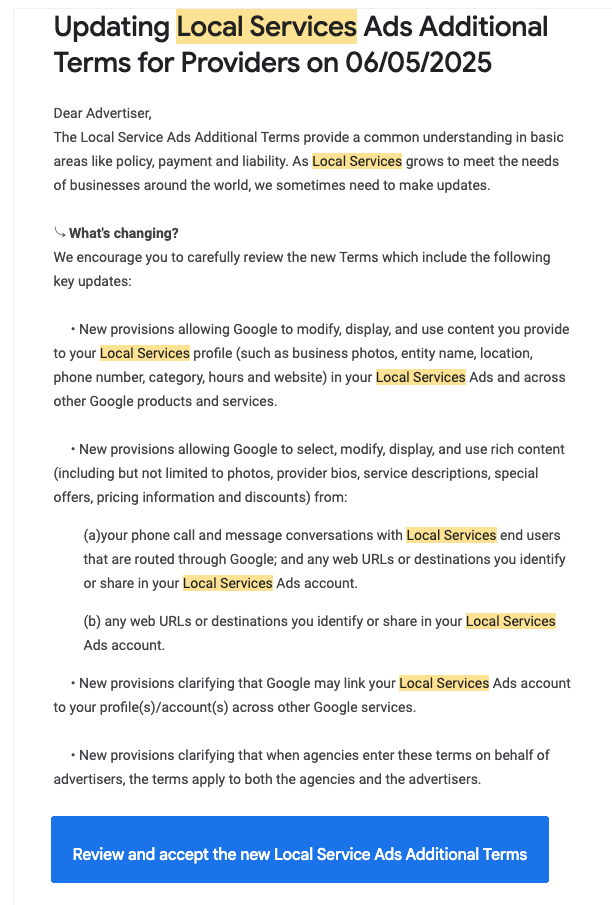
On April 22, 2025, Google sent an email updating Local Services Ads Additional Terms for Providers:
Subject: Action required: important updates to Local Service Ads Additional Terms
Many people are arguing that lawyers cannot participate in Local Services Ads, as this would constitute a per se violation of the Rules of Professional Conduct related to Confidentiality.
Here are a few thoughts.
First, I’m not a legal ethics expert. You should review your own RPCs and discuss these issues with your Bar and folks who provide ethics counsel for a living.
Second, since there are variations in the rules by jurisdiction, I’m going to focus on the ABA’s Model Rule 1.6: Confidentiality of Information, which says in relevant part:
(c) A lawyer shall make reasonable efforts to prevent the inadvertent or unauthorized disclosure of, or unauthorized access to, information relating to the representation of a client.
Of particular concern is Google’s proposed language:
New provisions allowing Google to select, modify, display, and use rich content (including but not limited to photos, provider bios, service descriptions, special offers, pricing information and discounts) from:
(a)your phone call and message conversations with Local Services end users that are routed through Google; and any web URLs or destinations you identify or share in your Local Services Ads account.
Not cool.
Are they saying they plan to use call and message conversations to display content?
Seems problematic.
Somewhat interestingly, at the time of writing, “display” does not appear in any of their linked terms.
Here’s what the (current) linked Local Services Additional Terms for Providers (United States) say:
Access to Data in the Service. You authorize Google, its affiliates, and their agents to access, monitor, and record telephone calls, text messages, live chat, and other communications initiated through the Programs (e.g., click-to-call ads). You also will obtain the necessary permissions required under local law and will notify your Team that these communications may be recorded and will obtain their consent to the recordings. Google may use information collected under this paragraph in compliance with its Privacy Policy and as Content under Section 3 above.
Of course, Google could change this at any time.
Nonetheless, the confidentiality question hinges on the concept of reasonableness.
Is it reasonable for a lawyer to conclude that Google won’t inadvertently disclose client confidences?
Great question.
I think this reasonableness standard is undergoing a massive evolution.
I recall when lawyers considered it unreasonable to use the cloud.
That didn’t age well.
The cloud protects client confidences much better than lawyers talking on their phones in public places.
There are legitimate reasons to be skeptical of Google.
But there are also legitimate reasons to believe that Google will do everything in its power to ensure that lawyers can still spend money on advertising there.
If you’re in the, “this is unethical camp,” check out Carolyn Elefant’s Can Lawyers Legally and Ethically Record Conversations With Clients Using Artificial Intelligence?
As Carolyn notes concerning Fireflies.AI:
Overall, the Fireflies.AIi terms and policies offer sufficient protection for most routine client communications. That said, mileage may vary depending upon the nature of a given matter and degree of sensitivity of the information so be sure to consider your unique use case in evaluating whether to transcribe client conversations with AI and what tools to choose.
This is a sound perspective.
I sense that many of you’re already using these tools without having reviewed their terms and policies or given much thought to whether they’re reasonable in light of the nature of the matter.
But that’s just a hunch.
In any case, most technology is moving towards AI.
And it will use your data to train.
You can certainly opt out.
But you’re likely to be at a massive competitive disadvantage.
🍿
Comments (1)
Wow, this looks pretty sneaky how Google and I’m sure other companies mislead people.
Leave a comment
Comments are moderated and appear once approved. Your email is never shown. Please don't share confidential details or ask for legal advice here.
Comments open soon.