
ChatGPT Legal Services Consumer Journeys and Marketing Attribution
 Gyi TsakalakisCo-founder, AttorneySync
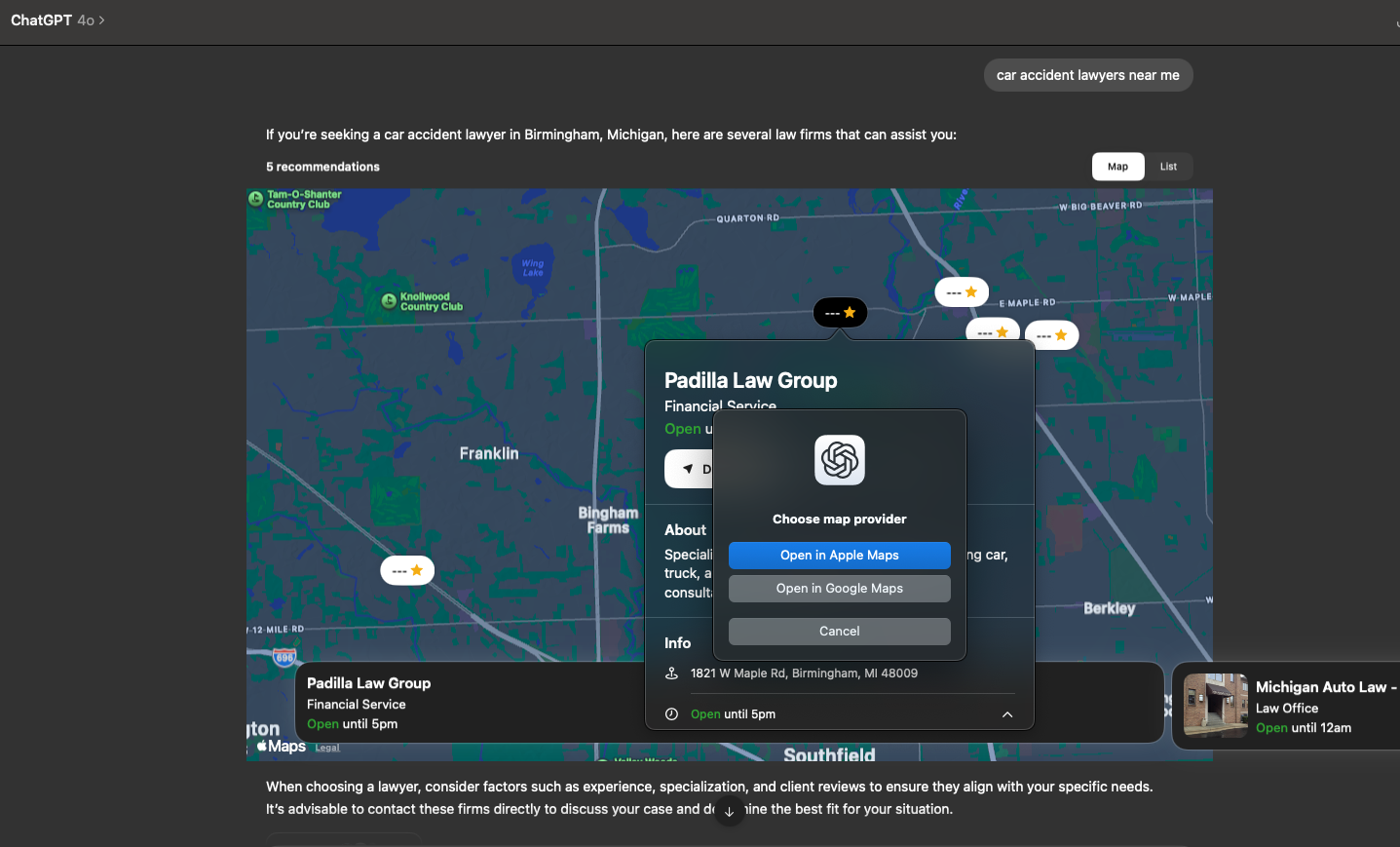
As more legal services consumers turn to ChatGPT for local law firm recommendations, a fascinating intersection between AI, search, and maps unfolds. While Google remains the undisputed leader in local business data, ChatGPT is increasingly becoming an entry point for searchers seeking legal representation.
But here’s the kicker: instead of keeping users within its ecosystem, ChatGPT often directs them back to Google Maps, Apple Maps, and traditional search results. This shift raises critical questions about attribution—how do we measure and understand how these clients find their way to law firms?
The Attribution Black Hole
In this evolving landscape, the traditional models of attribution, last-click, first-touch, and multi-touch start to break down. When a legal services consumer asks ChatGPT, “Who are the best car accident lawyers near me?” They receive a curated list, often pulled from Google and Apple Maps. Clicking a link from ChatGPT sends them back to Google Maps, where they might click to call, visit a website, or get directions.
Now, when that client eventually retains an attorney and is asked, “How did you find us?” what’s their response likely to be?
- Google? Because that was the last app they used.
- Search? Because that’s how they conceptualize looking for a lawyer.
- Online? Because the journey was fragmented.
What’s unlikely? “I asked ChatGPT.” Therein lies the problem. AI-driven consumer touchpoints become invisible in traditional reporting structures without quantitative tracking mechanisms.
The Challenge for Legal Marketers
For firms investing in local SEO, Google Business Profile (GBP), and Local Services Ads (LSAs), this new pathway complicates attribution models:
- Local SEO practitioners might claim credit for traffic originating from ChatGPT but landing on Google Maps.
- Self-reported attribution is more unreliable than ever, as searchers don’t consciously recognize AI’s role in their journey.
This AI-driven funnel remains difficult to parse even with call tracking and UTM parameters.
The Way Forward: AI-Aware Attribution
Legal marketers need to evolve their approach to attribution by:
- Leveraging AI-specific touchpoints: Encouraging direct engagement with AI channels by tracking referrals from OpenAI’s ecosystem (when available).
- Enhancing First-Party Data: Asking better intake questions like, “Did you use an AI assistant, search engine, or a maps app to find us?” instead of, “How did you hear about us?”
- Experimenting with ChatGPT Plugins: As OpenAI expands integrations, legal marketers should explore ways to connect directly with AI-driven search paths.
- Shifting to Incremental Lift Measurement – Comparing overall traffic trends before and after investing in AI-focused optimizations.
The Bottom Line
ChatGPT is reshaping legal consumer journeys, but its role is mainly invisible in current attribution models. Law firm marketers must rethink how we capture and measure AI-driven referrals to avoid misattributing conversions. The firms that adapt will gain a more transparent, more accurate view of how potential clients find them in an AI-first world.
P.S. I’m publishing more AttorneySync content over on Reddit.
Comments (0)
No comments yet. Start the conversation.
Leave a comment
Comments are moderated and appear once approved. Your email is never shown. Please don't share confidential details or ask for legal advice here.
Comments open soon.