
The Cost-Per-Case Trap: Why Chasing Cheaper Cases Can Shrink Your Law Firm

Gyi TsakalakisPresident, AttorneySync
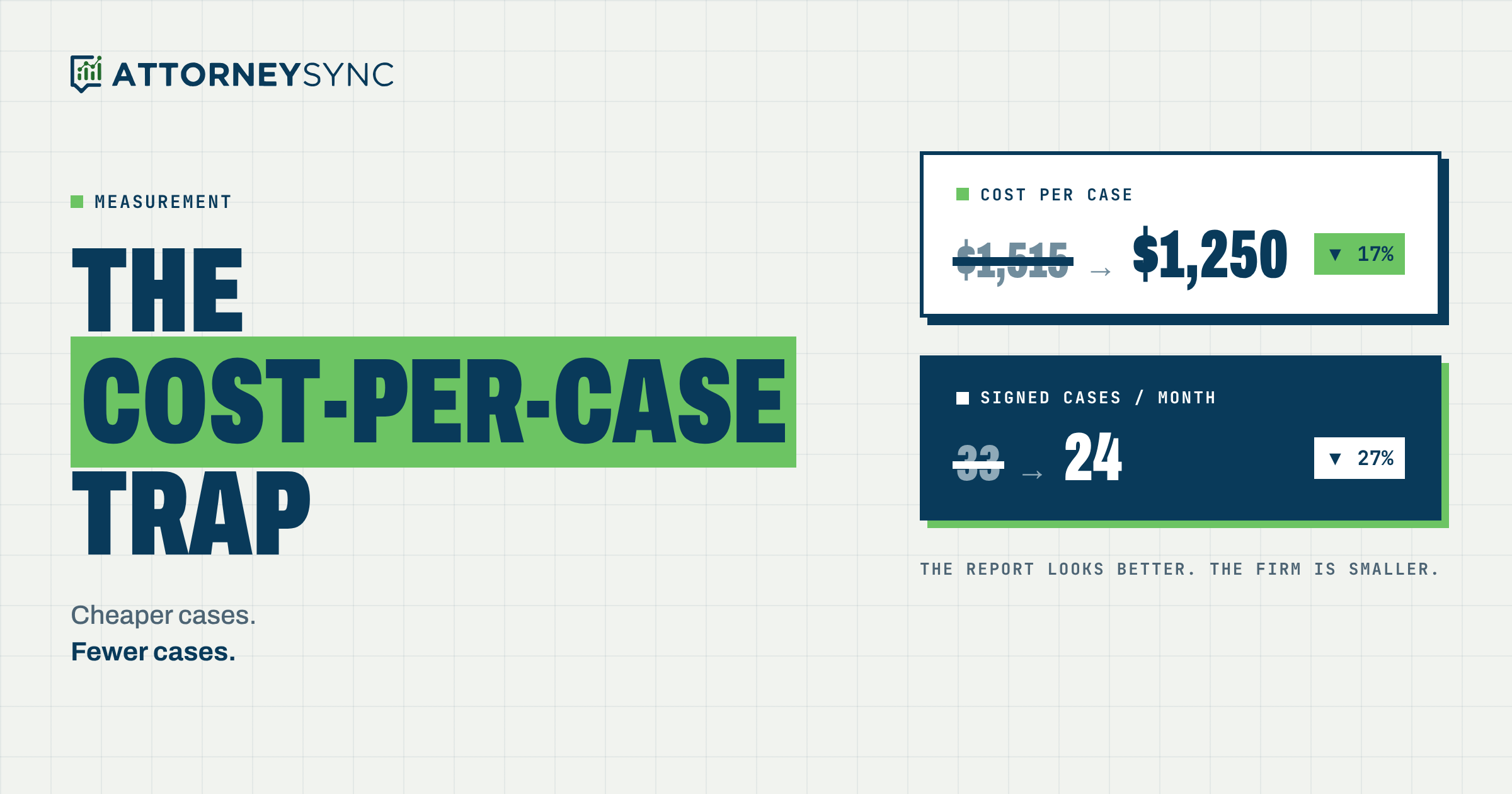
Cost per case is a useful number, and at times a useful target. A firm with a fixed budget, limited capacity to take on cases, or a new channel to prove can reasonably manage to it. The trouble comes when the target is cut off from what the firm is trying to grow. A firm that wants more cases, or bigger ones, but manages its marketing mainly by pushing cost per case down usually ends up with fewer cases, and often fewer of the cases that pay the bills.
I hear the same question in almost every first meeting with a firm: “What’s your cost per case?” It’s a fair question. It is simple, it fits on one line of a monthly report, and it feels like accountability. Divide what you spent by the cases you signed, and you have a single number to judge a vendor or a channel.
The trouble starts when that number becomes the target on its own, with no growth goal attached. A firm that tells its agency “get our cost per case under $X” has, without meaning to, also told it to spend less, bid less, and stop chasing the clicks and calls that cost more. Those more expensive leads are often where the growth is. Economists have a name for this. It’s called Goodhart’s law, after British economist Charles Goodhart, and it’s usually summarized this way: “When a measure becomes a target, it ceases to be a good measure.”
Applied to legal marketing, Goodhart’s law works like this. As long as cost per case is just something you watch, it tells you something real about how efficiently your marketing turns dollars into clients. Once a vendor’s contract, a marketing director’s bonus, or a budget decision depends on hitting it, everyone involved has a reason to move the number. And there are many ways to move it that don’t help the firm:
- Cut the most expensive spending. Dropping the costliest keywords, hours, or markets lowers the average immediately. It also drops the cases those dollars were bringing in.
- Lean on cases that would have come anyway. Bidding on your own firm’s name, or crediting paid ads with clients who were referred or already knew you, makes a channel look cheap without adding a single new client.
- Loosen intake. Signing callers the firm would once have declined raises the case count and lowers cost per case. It also fills the docket with low-value files.
- Redefine “case.” Counting signed retainers instead of cases that stay open, or counting leads that later drop out, flatters the denominator.
- Shift the timing. Pulling back spend late in a reporting period, while cases from earlier spend are still signing, makes one month look efficient at the expense of the next.
None of this requires bad faith. It’s what happens when a single number becomes the job. The cost-per-case figure keeps improving, and it stops telling you whether your marketing is growing the firm. That’s when it ceases to be a good measure.
In this post, I’ll walk through why that happens, what Google’s own documentation says about it, and what I’d manage to instead.
Why a lower cost per case usually means fewer cases
Every marketing channel has a most efficient set of opportunities: the places where what you pay and your odds of signing the client line up best. Those aren’t always the obvious ones. High-intent searches like “car accident lawyer near me” draw the most competition and some of the highest cost per click in legal advertising, so they can produce some of the most expensive cases a firm signs. The efficient wins are often elsewhere: more specific searches competitors overlook, the markets and hours where your intake converts best, and the ads and pages that turn the most callers into clients. A well-run campaign captures those first. To sign more cases, you have to reach further, into the costlier head-term auctions, broader keywords, wider geography, and more competitive placements. Each step tends to cost more per signed case than the one before it.
That means your average cost per case and the cost of your next case are two different numbers. Marketers call the second one marginal cost per acquisition. It’s why I’ve said on the Lunch Hour Legal Marketing podcast that optimizing to your cost per acquisition is probably the wrong thing to optimize to. I’d rather see a firm watch how its cost per acquisition changes over time, and what volume comes with it.
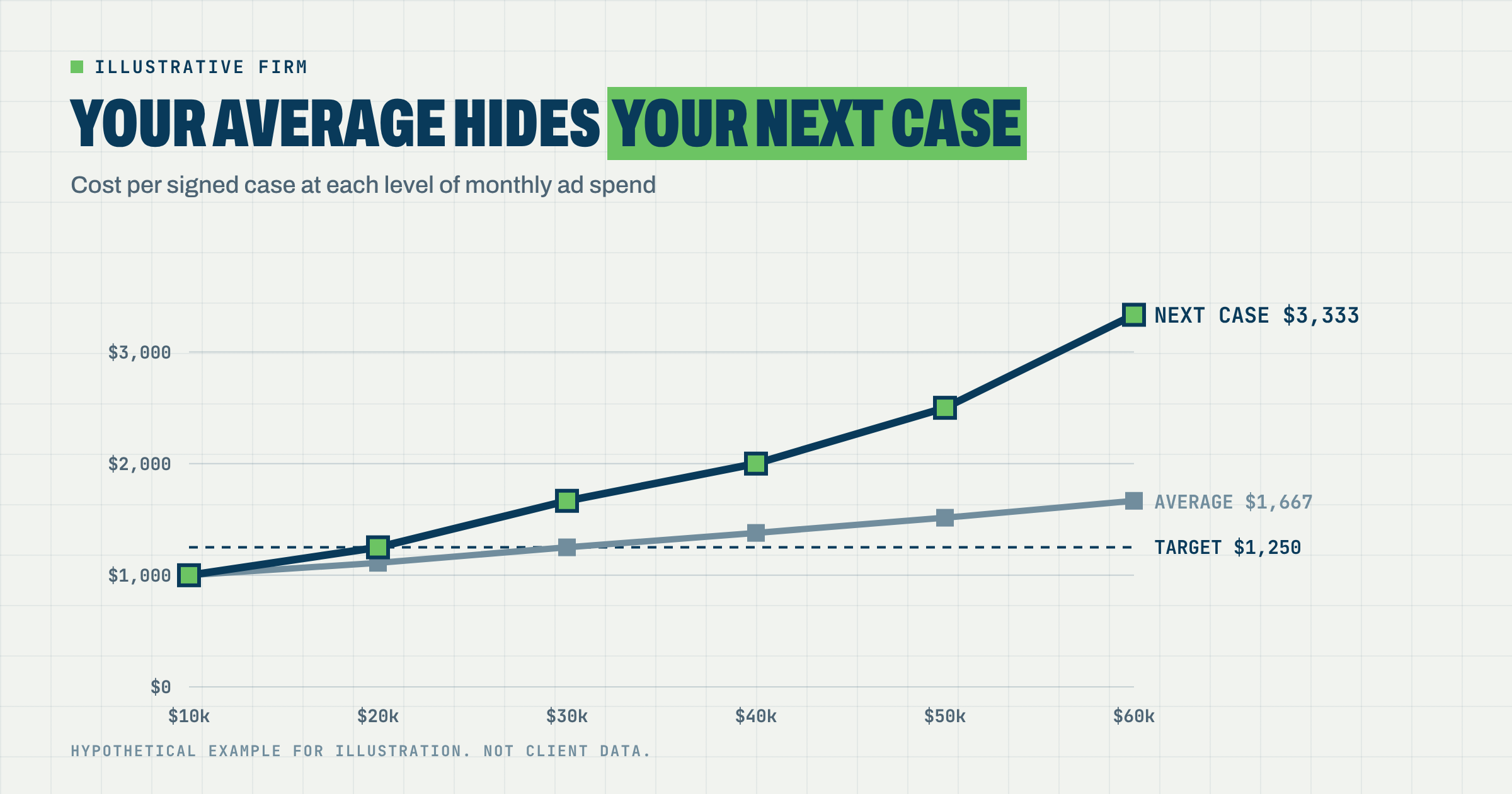
The chart follows a hypothetical firm as it spends more. Its average cost per case climbs gently, from $1,000 to $1,667. The cost of each additional case climbs much faster. So when the firm demands a lower average, the only way to deliver it is to cut off the expensive end of the curve, and those are real cases.
Here is what that looks like if the firm averages a $6,000 attorney fee per case (my assumption for the example) and its agency is told to hit a $1,250 cost per case:
| Monthly ad spend | Signed cases | Fee revenue | Revenue minus ad spend |
|---|---|---|---|
| $30,000 (hits the $1,250 target) | 24 | $144,000 | $114,000 |
| $50,000 (average of $1,515 per case) | 33 | $198,000 | $148,000 |
Hitting the target improves cost per case by 17%. It also costs the firm 9 cases a month (27% of its volume) and $34,000 a month in net fee revenue. The report looks better. The firm is smaller.
What Google says, and what I see
You don’t have to take my word for it. Google, which runs the auction most law firms rely on, says the same thing in its own documentation.
Google says a lower target means fewer conversions. Many law firms run paid search on Google’s automated bidding, and a common setting is Target CPA (cost per acquisition). Google’s help page on that setting warns that “setting a target that’s too low, for example, may cause you to forgo clicks that could result in conversions.” Its guidance on adjusting targets goes further: “a major change in targets can have a similarly sized impact on spend or volume,” and “if you would like to increase spend, you can raise CPA targets.” In other words, Google’s own lever for growth is a higher cost-per-acquisition target. Cut the target and the system bids less, enters fewer auctions, and signs you fewer clients.
Growth needs volume, not just a low number. A marketing channel only matters if it produces cases at a volume that can support your practice or hit your growth objective. A channel that signs a handful of cheap cases can win on cost per case and still do nothing for the firm. So when a firm tells me a channel has a great cost per case, my next question is always: how many cases are you actually opening from it?
Cost per case only means something in context. When my Lunch Hour Legal Marketing co-host Conrad Saam and I looked at a firm spending about $6,000 a year on a directory listing, my first question was whether that was 100% of the firm’s marketing budget or 1%. The same cost per case can be a rounding error or a crisis, depending on how much volume sits behind it. The math is often incomplete, too. Divide the clients you got from pay-per-click by your media spend and you have a cost per client, but you’re not getting the full picture.
Competition is pushing costs up anyway. In personal injury especially, cost per acquisition and cost per case are going through the roof. In a market like that, a firm that insists on last year’s cost per case isn’t holding steady. It’s choosing to sign fewer cases than it did last year.
A cheap case is not the same as a good case
Cost per case treats every signed case as equal. Your fee ledger does not. A soft-tissue fender-bender and a commercial trucking case each count as “one case,” but the fees can differ by a factor of ten or more.
That matters, but not in the tidy way most people assume. It’s tempting to think search intent tells you what a case is worth: “truck accident lawyer” must bring bigger cases than “car accident lawyer near me.” Sometimes it does. But in personal injury, the value of a case varies wildly regardless of how the person found you. Two people can type the exact same words into Google on the same afternoon. One has a sore neck and a few thousand dollars in medical bills. The other has a spinal injury and was hit by a driver with a commercial policy. At the moment of the click, nobody knows which is which: not Google, not your agency, and often not your intake team.
That adds a layer of complexity that cost per case can’t handle on its own:
- Case value is lopsided. In my experience, a small share of a PI firm’s cases produces a large share of its fees. The average fee per case gets pulled up by a few big outcomes that are rare and hard to predict.
- Volume is how you find the big cases. If you can’t predict which inquiry becomes the case that makes your year, the number of cases you sign is the number of chances you get. Cutting volume to hit a lower cost per case doesn’t just cost you average cases. It costs you some of your shots at the outliers.
- Cost per case and case value have to be read together, over time. A channel can look expensive for six months and then produce one case that pays for years of spend. Judge sources on groups of cases big enough, and old enough, to include those outcomes. Tie fees back to where each case actually came from, not to what the keyword seemed to promise.
- Small samples mislead. At a few signed cases a month, the average fee per case for any one channel swings with every settlement. Be careful about cutting a channel based on a handful of resolved files.
So a firm that pushes hard on cost per case doesn’t just drift toward cheaper searches. It signs fewer cases, which means fewer chances at the ones that pay the bills.
Once you have enough resolved cases to trust the averages, compare channels on what they earn as well as what they cost. Take two hypothetical channels:
| Channel | Cost per signed case | Average fee per case | Fee dollars per marketing dollar |
|---|---|---|---|
| Channel A | $800 | $3,000 | $3.75 |
| Channel B | $2,500 | $15,000 | $6.00 |
Judged by cost per case, Channel A wins easily and Channel B looks three times too expensive. Judged by what the firm actually earns, Channel B returns 60% more per dollar. A firm managing to cost per case cuts Channel B first.
The same logic applies to intake. A firm can lower its cost per case by signing more marginal callers, the ones it might have declined a year ago. The cost-per-case report improves while caseload quality, staff time per dollar of fee, and eventually revenue get worse.
Brand and direct response don’t share a cost per case
Cost per case means something different depending on whether a dollar captures demand or creates it. Judging both by the same number almost always favors capture and starves the brand work that feeds it.
| Demand capture (direct response) | Demand generation (brand) | |
|---|---|---|
| Examples | Google Ads, Local Services Ads, directories, retargeting | TV, radio, billboards, streaming and YouTube video, sponsorships |
| Who it reaches | People already looking for a lawyer right now | People who will need a lawyer later, or will refer someone who does |
| When cases arrive | Days to weeks | Months to years, often through another channel |
| What cost per case shows | A fair read on efficiency, within the limits of how much demand exists | Usually looks high or impossible to measure, because the cases it creates get credited elsewhere |
| Better measures | Marginal cost per case, fee revenue per dollar | Branded search volume, direct calls, referral volume, share of new cases that already knew the firm’s name |
Capture has a ceiling. Direct response can only win the people already searching. In any market, that pool is only so big. Once a firm is buying most of the affordable clicks and calls, more spend buys more expensive ones, which is the rising marginal cost shown above. Lowering the cost-per-case target just shrinks the slice of that pool the firm is willing to pay for.
Brand raises the ceiling, and cost per case can’t see it. A billboard or a TV spot rarely produces a call you can trace back to it. What it produces is the injured person who searches the firm by name, picks its ad over an unfamiliar one, or calls the number a friend remembered. Those cases show up as branded search, direct calls, or referrals. They make the capture channels look cheaper, while the brand spend that created them looks like it signed nothing.
So a cost-per-case target cuts brand first. When the target tightens, the channel with the worst attributed cost per case goes first, and that is almost always brand. The effect isn’t immediate. Branded searches and name recognition fade over months, and the capture channels slowly get more expensive as the firm competes for strangers instead of people who already know it. By then the cut looks unrelated.
I’ll put it bluntly: everybody is over-indexing on direct response. If your firm is 80% direct response and 20% hyper-local brand, I’d be working to flip that on its head. One of the biggest surprises for me has been seeing the impact of brand even in non-brand search. I’ve watched a recorded search session where one person’s journey began as a direct response, demand capture search and evolved, right before our eyes, into a brand search. The lesson for measurement: judge capture by what the next case costs and earns, and judge brand by whether more people come to you already knowing your name.
What to measure instead
Keep cost per case on the report. It is a fine diagnostic for spotting a broken landing page or an intake problem. It can work as a target, too, when it’s set against your growth goal: for example, the most you’re willing to pay per case to sign 40 cases a month. What doesn’t work is a target that only ever moves down. These numbers tell you more about whether your marketing is growing the firm:
- Marginal cost per case. When you added (or cut) the last block of spend, how many cases did it add (or lose)? Divide the change in spend by the change in cases. As long as the next case costs well under what it earns, spending more is the right call, even if the average rises.
- Fee revenue per marketing dollar. Tie signed cases to the fees they eventually produce, by channel and by case type. This is the number that separates Channel A from Channel B above.
- Total signed cases and case mix. Track volume alongside cost, broken out by case type or expected value. A falling cost per case with falling volume is a warning sign, not a win.
- Net fee revenue after marketing. Fees earned minus marketing spent. This is the number the managing partner actually takes home, and it is the one a cost-per-case target can quietly shrink.
- Time to resolution. Contingency fees arrive months or years after the ad spend. Judge channels on cohorts of cases signed in the same period, and give a new channel enough time to show what its cases are worth before you cut it.
None of these require perfect attribution. They require connecting your marketing data to your case management system, so the conversation moves from “what did a case cost?” to “what did that spending earn?”
A better question for your next marketing review
Next time you review your marketing numbers, try these questions alongside the usual one:
- If we added $10,000 a month to our best channel, how many more cases would it sign, and what would they be worth?
- Which channels bring in our highest-value case types, and what do those cases cost?
- Are our total signed cases and net fee revenue growing, flat, or shrinking?
- When we last cut spend to improve cost per case, what happened to volume over the next six months?
A firm that grows tends to accept a higher average cost per case, because it is buying cases that a more cautious competitor won’t pay for. A firm that manages only to cost per case will usually find its marketing gets cheaper and its caseload gets smaller.
At AttorneySync, we connect marketing spend to signed cases and case value, so firms can see what their marketing earns and not just what it costs. If you’d like to see where your next case is coming from, and what it’s worth, let’s talk.